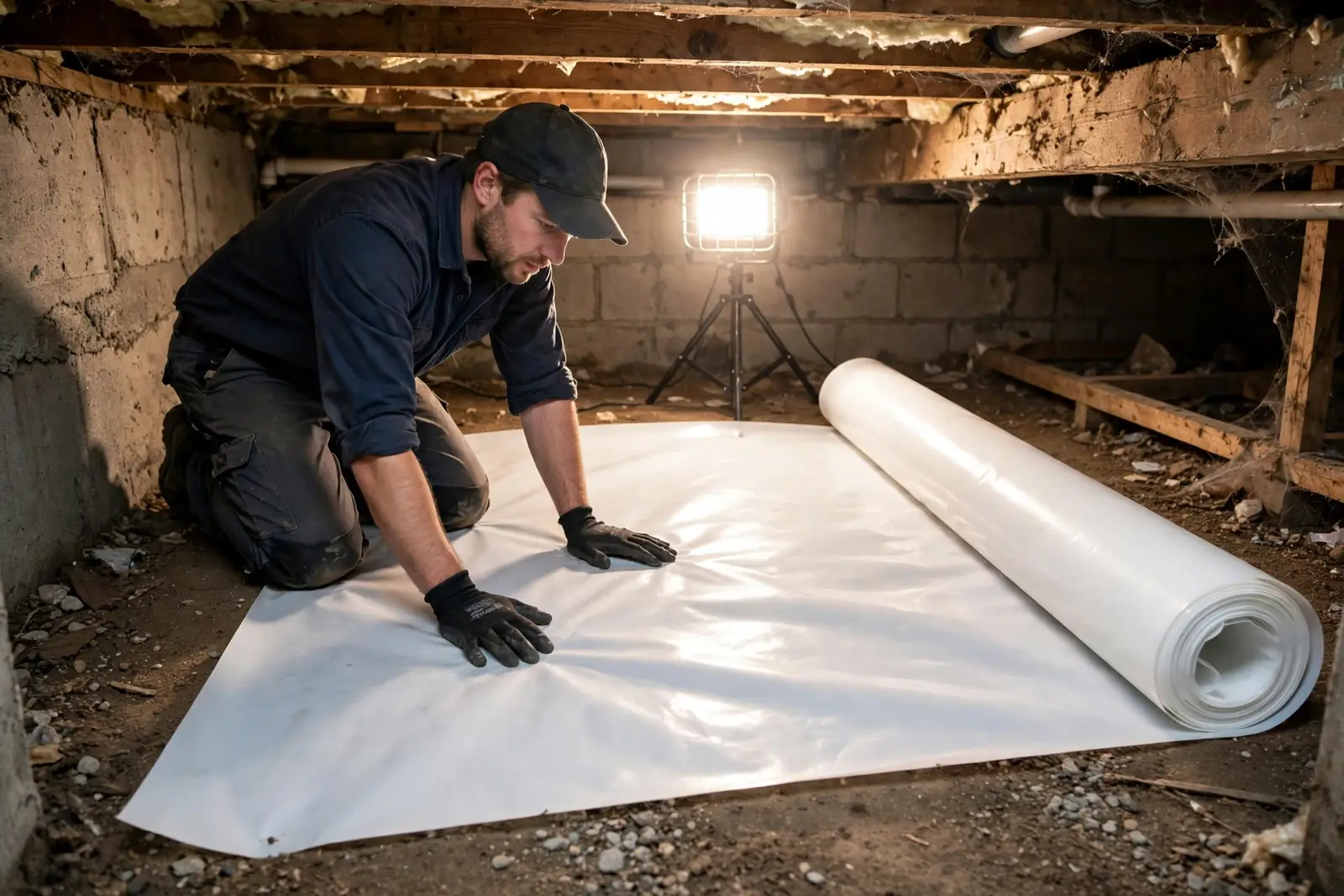
Not every crawl space needs the full encapsulation system on day one. Sometimes the right scope is a properly installed vapor barrier: a heavy, sealed ground cover that shuts off the moisture rising out of the soil. Shelby County clay pumps vapor into crawl space air around the clock, and a failed ground cover leaves the soil effectively uncovered. But "vapor barrier" covers everything from thin plastic tossed on dirt to a 20-mil reinforced liner sealed at every seam, and those two things have almost nothing in common. Vapor barrier installation in Hoover, AL, done right, is described on this page: the material, the detailing, and the honest difference from full encapsulation.
Call (205) 208-7286 or get a free inspection. We will tell you whether the barrier alone solves your problem.
Builder-grade ground cover fails in predictable ways, and it fails on a schedule: roughly 10 to 15 years in our soils. Three failure modes below, and a simple flashlight is all the diagnostic equipment you need.
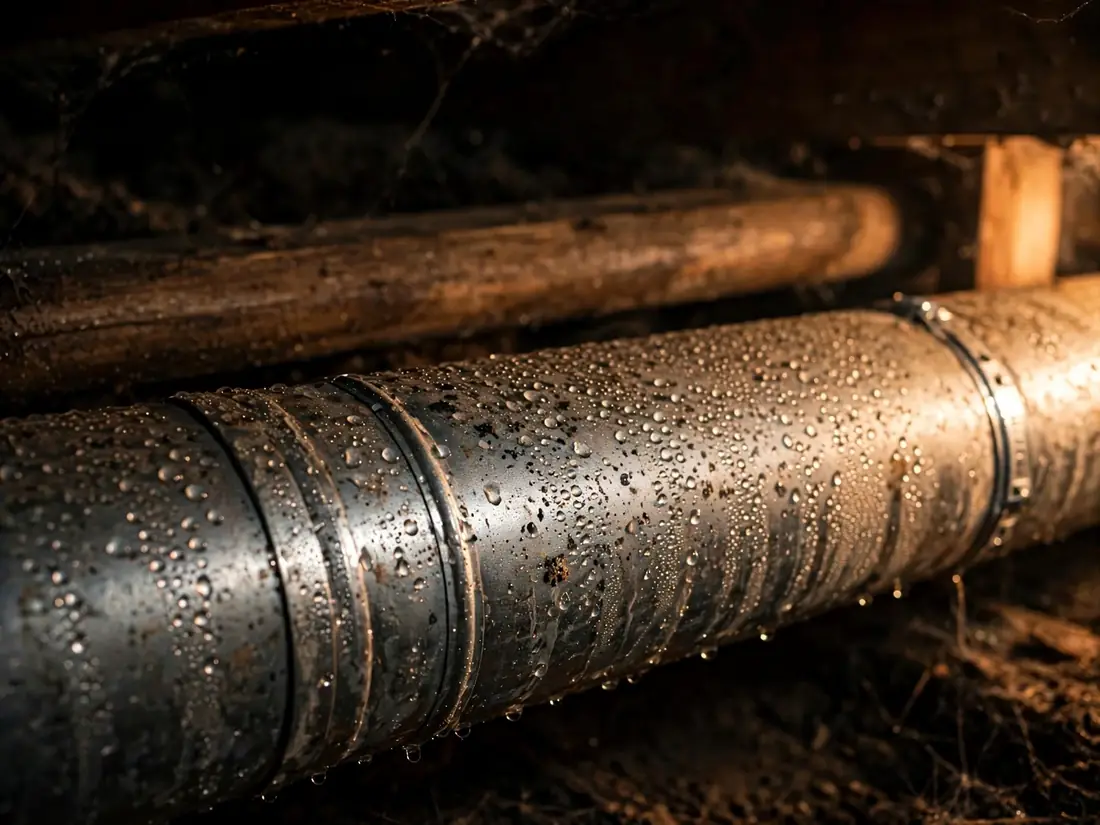
Builder-grade 6-mil poly tears underfoot. Every plumber, electrician, and HVAC tech who has crawled under your house has walked on it. After a decade or two, it is confetti with gaps: torn, displaced, bunched in corners, with bare soil showing through everywhere the sheets have pulled back. A barrier full of holes is not a barrier; it is a suggestion.
A degraded ground cover holds puddles on top instead of keeping moisture down, and it hides the moisture problem from anyone who glances in and assumes the plastic means the space is protected. Puddles on the liner mean the liner is done working, and the soil underneath is breathing vapor straight past it.
Even where the poly survives, the sheets were overlapped, not sealed. An overlapped seam is a gap every few feet once the sheets shift, and they always shift. Vapor walks right through unsealed seams, which is why sealing is half the product.
If the crawl space air stays damp with the ground covered, the cover has failed, the vents are importing more moisture than the ground ever produced, or very often both. The inspection separates those two with a moisture meter in about five minutes.
Hardware-store plastic and a pro liner are different products. Four differences, each one the reason the cheap version fails.
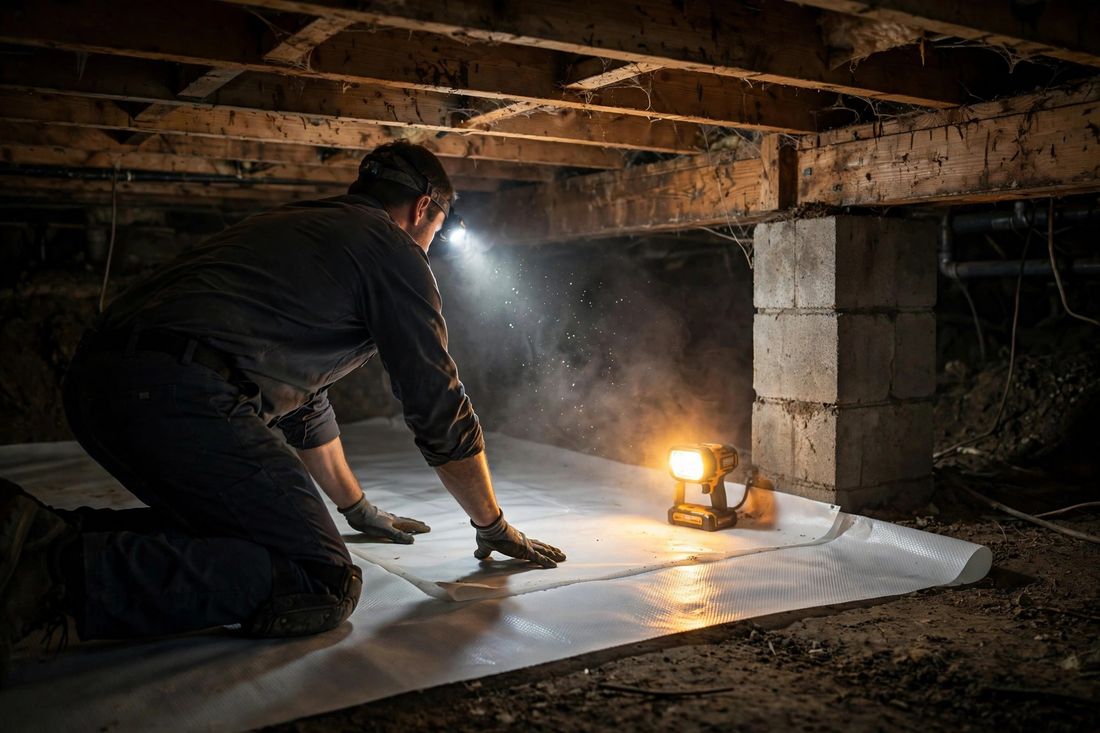
Six-mil polyethylene is code-minimum ground cover. It tears on sharp stone, punctures under foot traffic, and degrades where sunlight hits it at the vents. Twenty-mil reinforced liner is a different product entirely: thick enough to walk on, tough enough to survive service traffic, stable enough to hold a seal at the walls for decades. The cost difference on a typical Hoover crawl space is small. The lifespan difference is measured in decades.
A reinforced liner has a cross-woven cord grid laminated between layers of polyethylene. That grid stops a tear from running. Puncture a 6-mil sheet and the tear spreads; puncture a reinforced 20-mil liner and the damage stays local. Every service visit puts feet on the liner. Unreinforced material does not survive that reality.
Twelve-inch overlaps sealed with butyl tape formulated for polyethylene, applied to clean, dry material. The liner runs up the foundation walls and is mechanically fastened so it cannot slump. Each pier gets wrapped and sealed, and every penetration gets cut tight and taped. The whole surface, not just the floor. A thick material with open seams is not a barrier.
In Alabama, we leave a three-inch inspection gap at the top of the foundation wall, between the top of the wall liner and the sill plate. Termite inspectors need to see the wall surface to spot mud tubes. Any installer who runs liner tight to the sill in termite country is trading your termite visibility for a slightly better vapor seal, and it is a bad trade.
A standalone vapor barrier is priced by square footage and prep work. The liner material is the smallest part of the cost; the labor is the detailing: ground prep, debris and old failed material out, twelve-inch sealed overlaps, wall coverage, pier wraps, taped penetrations.
What drives your number: square footage, how much failed material has to come out first, how tight the access is, and whether the ground needs leveling. The step from 12-mil to 20-mil reinforced on a typical Hoover crawl space is small compared to the cost of replacing a failed barrier five years from now. We install 20-mil reinforced as the standalone scope, because a barrier is the entire point of the visit.
What you will not get: a quote for plastic tossed on dirt and called encapsulation. If your vents are open and the humidity is high, we will tell you the barrier alone is a down payment, not the solution. Call (205) 208-7286 and we will scope it honestly.
HOW A JOB RUNS
Ground prep first. The field is easy; the edges and seams are the product.
01
The free inspection comes first. We look at your ground cover and tell you its real condition: thickness, tears, seams, wall coverage. Then we tell you whether the barrier alone solves your problem.
02
Photos of everything, findings in plain language. If the vents and humidity need the full treatment, the plan says so before you sign anything.
03
Square footage, prep work, material spec: 20-mil reinforced, every time. Itemized and signed before work starts. No bundled mystery numbers, no substitutions on install day.
04
Ground prepped, liner laid, seams taped, walls fastened, piers wrapped, termite gap left. Contained work area, photographed when we are done, and built to survive service traffic for decades.
Straight answers about vapor barrier installation in Hoover, AL.
A vapor barrier is one component: a sealed ground cover that stops soil moisture. Encapsulation is the full system: sealed liner plus sealed vents, sealed access door, drainage where needed, and active dehumidification. A barrier stops ground vapor. Encapsulation stops ground vapor and everything else.
For a ground cover nobody will ever walk on, 12-mil is durable. But crawl spaces get walked in: HVAC techs, plumbers, inspectors, us. We install 20-mil reinforced because it survives service traffic without puncturing.
It will reduce it, because a large share of crawl space moisture starts at the soil surface. But if the smell is strong, the vents are open, or there is visible mold on the joists, the barrier alone will not finish the job. Smell is a symptom; the inspection finds the cause.
Decades, when installed correctly. The material does not have an expiration date. What ends a barrier's life is physical damage, failed seams from cheap tape, or a water event it was never designed to handle.
You can buy the material, and a careful homeowner can do a decent ground-only installation on an accessible crawl space. What usually goes wrong in DIY jobs is the detailing: short overlaps, hardware-store tape, no wall coverage, piers left bare, penetrations unsealed. The field is easy. The edges and seams are the product.
The three-inch termite inspection gap lets pest inspectors see mud tubes on the foundation wall. In Alabama's termite pressure, hiding the wall behind liner trades a small vapor improvement for a real inspection blind spot.
The full sealed system the barrier belongs to. Barrier, vents, dehumidifier, one scope. Get the full system
Active humidity control for the sealed space. Size the unit
Wall insulation for sealed spaces, done to code. The right thermal boundary. Insulate it right
Looking at the whole picture? See all eight crawl space services.
FREE INSPECTION
We will come look at it and tell you whether a proper vapor barrier solves your problem or whether the vents and humidity need the full treatment. Either way, you get an honest scope, a straight price, and photos of what we found.
Call (205) 208-7286 for a free inspection. We serve Hoover and the Birmingham metro, and we answer our own phone.
