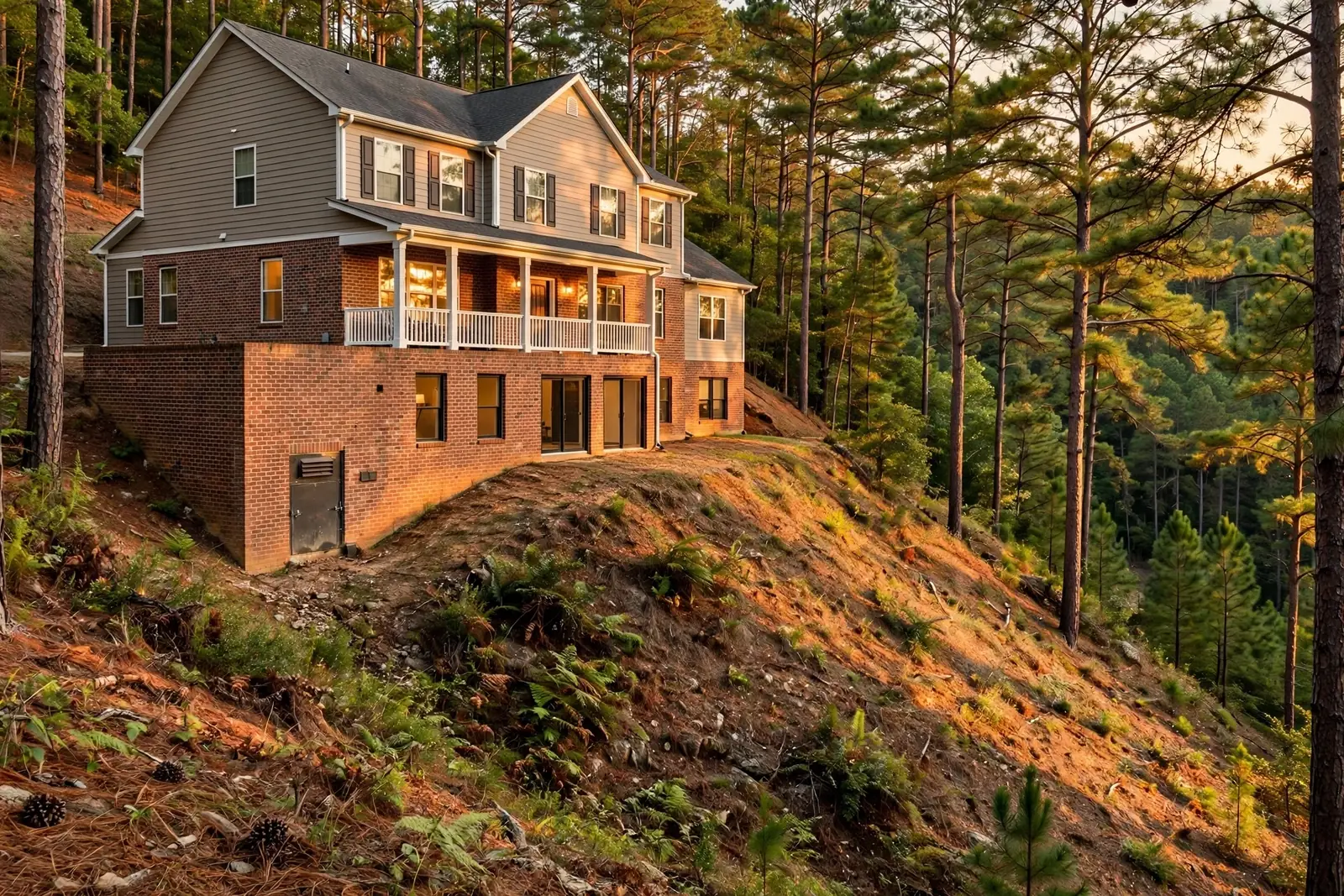
Vestavia Hills is built on a mountain, and that changes everything about its crawl spaces. Shades Mountain runs through the city like a spine, and homes in Rocky Ridge, Grants Mill, Meadowbrook, and the Crestline-area subdivisions mostly sit on slopes that move a surprising amount of water during a storm. Crawl space encapsulation in Vestavia Hills, AL starts with the slope, because water runs downhill, and on a hillside lot, downhill often ends at your foundation.
Not every Vestavia Hills crawl space needs the same work. But almost every one on a slope fights the same enemy: water arriving from uphill. A home cut into Shades Mountain collects runoff from every square foot of yard above it. Clay-heavy soil absorbs it slowly, so during hard storms the water sits against the foundation and pushes sideways. That is why we walk the grading on every Vestavia Hills inspection, not just the crawl space.
On flat ground, surface water spreads. On a hillside, it concentrates. A home cut into a slope collects runoff from every square foot of yard above it, and if the grading sends that water along the foundation instead of around it, the crawl space becomes the drain the lot never had. We see this on lot after lot: the uphill side of the yard bone dry, the downhill side of the crawl space wet.
The clay-heavy soil under this part of the metro absorbs water slowly. During a hard storm, water sits against the foundation walls and pushes sideways for days after the rain stops. Engineers call it hydrostatic pressure. On the truck, we call it the reason hillside crawl spaces stay wet long after storms the homeowner never knew reached the crawl space.
Most Vestavia Hills homes, from the mid-century ranches along Shades Crest Road to the newer builds in Liberty Park, have a liner story in common: thin builder poly, or nothing at all, with seams never sealed and vents left open. Add hillside water pressure and decades of service traffic across the plastic, and the ground vapor protection is gone. Rolling a liner over a dirt floor while surface water still runs toward the foundation is cosmetic work. We fix the water first, then seal.
1960s stock, original vented dirt crawls, moisture spiking on the downhill side.
similar vintage, with grading that has settled back toward the house over the decades.
established subdivisions where the builder's moisture protection is aging out.
1990s builds, failed builder liners, and usually the cleaner job once water is handled.
2000s builds reaching the age where thin builder poly quietly quits.
FIELD CHECK
Vestavia Hills sits on a ridge, so this check looks outside the house as much as under it.
On a hillside lot, that water often finishes under the house. We walk the grading on every inspection, because downspout extensions and a swale can change the moisture math before any liner goes down.
Cut-and-fill hillside lots put the crawl space at the bottom of the drainage path. We check the downhill side first for entry marks and moisture spikes.
That smell starts below the floor. If the downhill side of the crawl space stays wet, the whole space stays humid, and the rooms above show it first.
If any of this sounds familiar, get a free inspection.
Crawl Space Drainage & Sump Pumps: interior perimeter drainage for hillside water, installed before the liner, not after.
Crawl Space Waterproofing: water entry diagnosed at the source, with the exterior walk-around included.
Crawl Space Encapsulation: the full sealed system, once the water is handled.
Every area we serve: the full Birmingham metro from our Hoover base.
More than almost any other factor we see in this city. A home cut into a hillside collects runoff from the yard above it, and clay soil holds that water against the foundation long after a storm. The fix is often as much outside the house as under it.
Often not. Builder-grade poly from that era is thin, and after twenty-plus years most of it is torn, displaced, or buried under dirt. The liner did its job for a decade and then quietly quit.
It depends on whether your crawl space takes on liquid water. Standing water marks, active seepage, or water entry during storms means interior drainage plus a sump. Damp from humidity alone means the sealed liner and dehumidifier handle it. We diagnose first.
In most cases, yes, because the smell starts below the floor. Sealing the ground vapor source, drying the air, and removing mold-damaged insulation removes the source instead of masking it. If the smell persists, we will point you at the HVAC or plumbing next.
Two to four days for most full encapsulations, longer with interior drainage or structural repair. You get a firm schedule at the inspection, before any work starts.
Published local ranges for full encapsulation run 3,500 to 7,000 dollars, and interior drainage is priced on top, usually per linear foot. Hillside jobs often need both, which is why the inspection prices every line separately.
FREE INSPECTION
If your home sits on one of the slopes of Shades Mountain, the crawl space under it deals with water the flat-land houses never see. Call (205) 208-7286 for a free 21-point inspection. We're based in Hoover and serve Vestavia Hills and the rest of the Birmingham metro. We'll get under the house, take the readings, walk the grading, and give you a straight answer with photos. Then the decision is yours.
