Straight answers to the questions Hoover homeowners actually ask us, grouped by topic: the basics, the money, the moisture, and working with us. No brochure language, no dodging, no "contact us for details" where a straight answer should be. If your question is not here, call us and ask it straight.
The what-is-it questions, answered once, well.
It is a sealed moisture-control system, not a product. A 20-mil reinforced liner sealed across the floor and up the walls, sealed foundation vents, a commercial dehumidifier sized to the space, and drainage where bulk water demands it. Installed in that order. Anything missing a piece is not really encapsulation.
A vapor barrier is one component: a sealed ground cover that stops soil moisture. Encapsulation is the full system: sealed liner plus sealed vents, sealed access door, drainage where needed, and active dehumidification. A barrier stops ground vapor. Encapsulation stops ground vapor and everything else the vents import.
Decades. The 20-mil reinforced liner does not have an expiration date; what ends a system's life is physical damage or a water event the drainage was never sized for. The dehumidifier and sump pump are the maintenance items, not the seal.
If the smell comes from crawl space moisture and microbial growth, which it usually does, yes. Sealing ground vapor, controlling humidity, and remediating existing growth removes the source rather than masking it.
Probably not anymore. Builder-grade 6-mil vapor barriers degrade in 10 to 15 years in Shelby County clay. If your home was built between 2000 and 2010, that plastic is likely torn, displaced, or gone.
It is one of the best pre-listing improvements for homes with moisture history. Home inspectors photograph crawl spaces, and "elevated moisture / microbial growth" in a report kills deals or triggers credits. A finished system with paperwork turns that line item into a selling point.
The money questions. For the full breakdown, see the cost guide.
Hoover-area contractors publish ranges of roughly $3,500 to $7,000 for a typical home. Your number depends on square footage, condition, access, and drainage needs. We quote only after the free inspection, because your crawl space decides the number.
Because they were not the same job. The low quote is usually barrier-only; the high quote is the full sealed system with dehumidification and possibly drainage. Ask every bidder for the same written scope and the quotes become comparable.
Yes: a full 21-point inspection with photos, free, no obligation. We do not quote over the phone, and we are suspicious of anyone who does. The inspection is how you get a real, itemized number.
Labor, by a wide margin. Crawl space work is slow, physical, and done in tight, hot spaces. The liner itself is a few hundred to a couple thousand dollars in material. What you are paying for is someone willing to do meticulous sealing work on their belly for days, and do it right.
It protects the structure under your home, where the expensive damage happens: rotted joists, subfloor replacement, mold remediation. We will not promise payback numbers we cannot measure in your house.
The water questions. The short version: water first, then seal.
Call us, ideally after a rain so we can see it at its worst. Standing water is a drainage scope, not a sealing scope: interior perimeter drainage and a sump pump move it out, then the sealed system goes on a dry space. See crawl space waterproofing.
Yes, if the mold was remediated first and the moisture source was fixed. Encapsulation prevents recurrence; it does not cure an existing infestation by itself. See crawl space mold removal for the remediation side.
Bleach kills surface mold on non-porous materials. Wood is porous: bleach does not reach the growth in the grain, and it adds moisture while you apply it. As a remediation strategy, it is not a strategy.
No. Drying between rains is normal; moisture cycling is the actual problem, and it never stops on its own. Every wet-dry cycle feeds mold, stresses wood, and moves that red clay around your foundation.
Less than you would think, but not zero. Check the dehumidifier's filter and condensate drain twice a year, test the sump pump before spring rains, and keep gutters and grading maintained outside.
The trust questions: the inspection, the crew, the no-pressure policy.
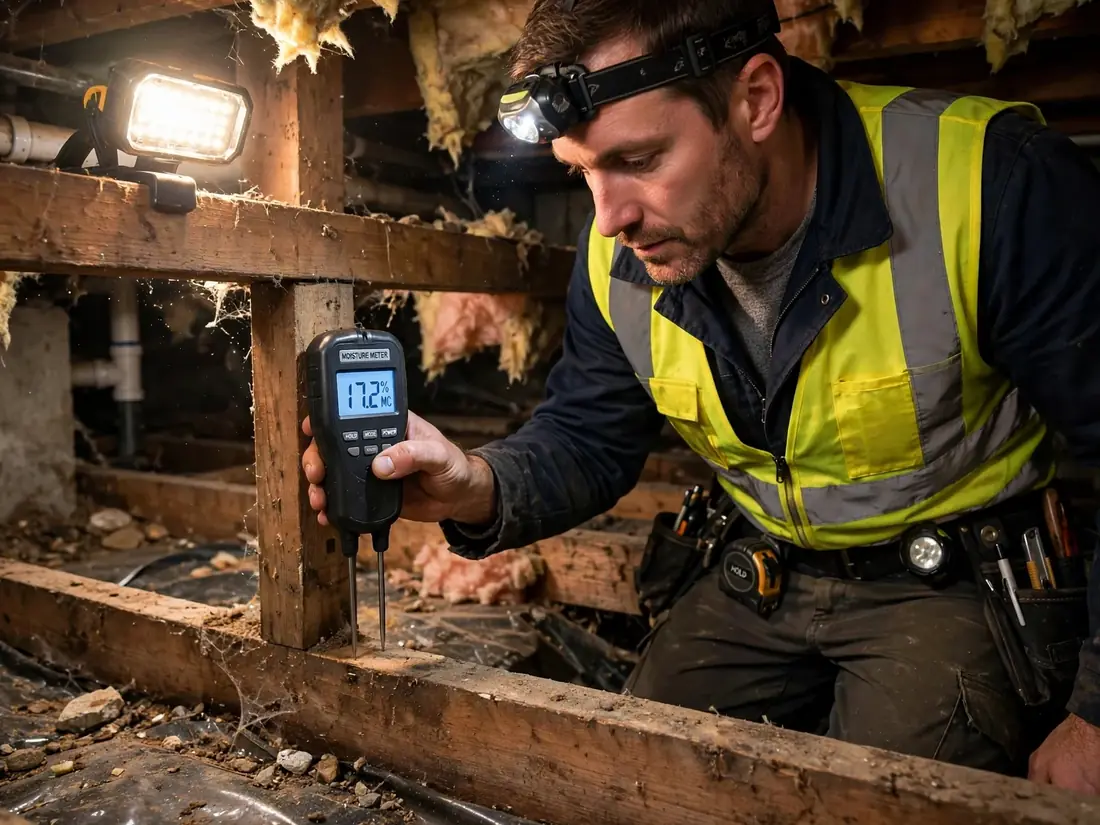
About 45 to 60 minutes. We walk the outside first: grading, downspouts, foundation. Then we go under with moisture meters and a camera for the full 21-point checklist. Photos and plain-language findings, yours to keep. See crawl space inspection.
No. If work is needed, you get an itemized quote to consider on your own time. We will not hover, and we will not call you five times if you need time to think. If your crawl space is fine, we say so and leave.
Most encapsulation jobs finish in 2 to 4 days. Barrier-only jobs take 1 to 2 days; jobs with drainage or structural repair can run a full week. We give you a real schedule at the inspection.
Our own crew, not day labor, not a subcontractor chain. One trade is all we do, so the people under your house have done this hundreds of times. More on the about page.
Call (205) 208-7286 and ask it. You will talk to someone who has been under hundreds of Hoover houses, not a call center. Or get the free inspection and ask us in person, under your house, looking at the actual thing.
FREE INSPECTION
Free 21-point inspection: moisture meters, camera, photos you keep. Plain-language findings, itemized quote if work is needed, no pressure either way. The inspection answers every question on this page with your house as the evidence, and it costs you nothing but 45 minutes of your day.
Call (205) 208-7286 or send the form. We serve Hoover and the Birmingham metro, and we answer our own phone.
