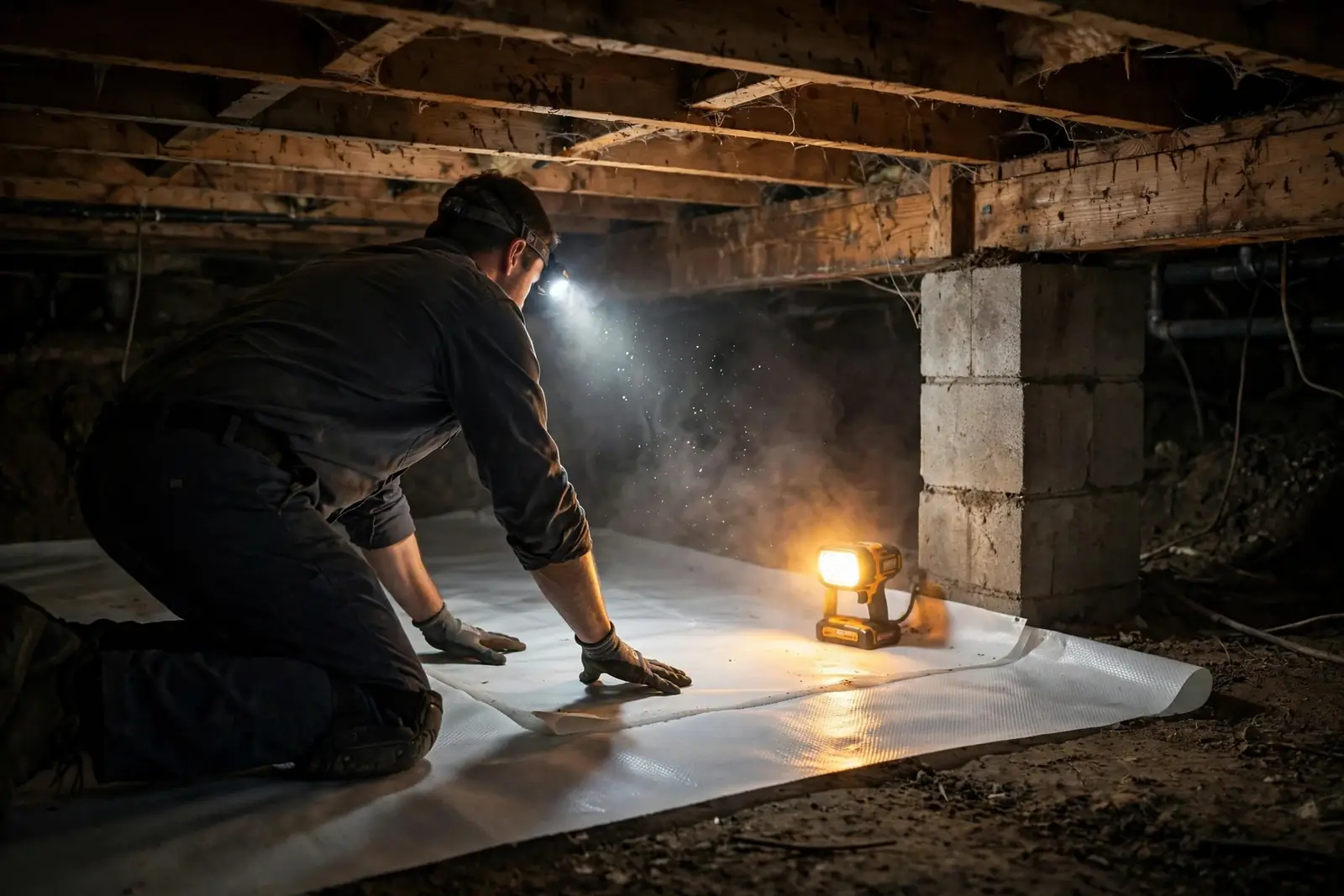
Most of the crawl spaces we crawl into around Hoover look the same: bare dirt or a thin sheet of torn plastic, open vents, damp block walls, air that smells like wet earth. Shelby County red clay feeds moisture into every one of them, and the humid summers do the rest. Crawl space encapsulation is how we close that wound. Not a single product, but a sealed system built in a specific order: water managed first, then the seal, then the air controlled. Get the order wrong and you get a lined swimming pool or mold sealed in with the framing. This page explains exactly what that system is, why Hoover homes need it, and where its limits are.
Call (205) 208-7286 or get a free inspection. One crew, one trade, and we answer our own phone.
Walk your house with fresh eyes. Most Hoover homeowners notice the symptoms upstairs long before they ever look under the house. If any of these sound familiar, the full system is probably the right scope, and the free inspection will confirm it with readings, not guesses.
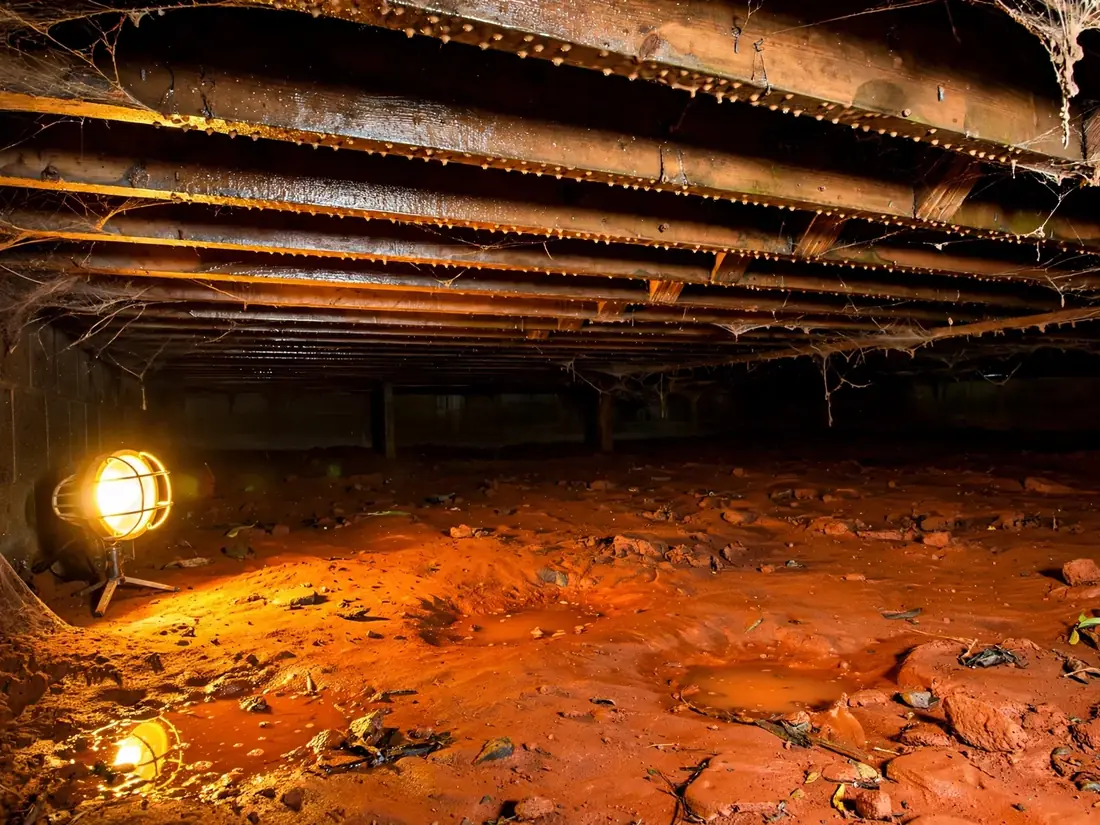
Builder-grade poly from the 2000s is past its 10 to 15 year life in Shelby County clay. Torn, displaced, bunched in corners, holding puddles on top instead of keeping moisture down. We see it under houses built in 2008 that owners assumed were still protected. A ground cover that is torn in five places is not a vapor barrier anymore; it is landscaping fabric for puddles.
Open vents import warm, humid air that condenses on cool ductwork and framing every summer, dripping onto joists and insulation for months. The vents are the moisture problem, not the solution, in this climate. A vented crawl space in Hoover runs damp for most of the warm half of the year, no matter what is on the ground, and no dehumidifier can keep up with open vents.
Sweating ducts, damp block walls, insulation sagging away from the subfloor. If your ductwork drips through July and August, the space is telling you the vents and the ground vapor are both winning. Sealing without dehumidifying will not finish the job.
Building scientists often cite that roughly 40% of first-floor indoor air originates from below the living space. The hallway smell starts under your floors, pulled up through plumbing chases and duct boots. Seal the source and the smell goes with it.
A job missing any one of these is not really encapsulation. Five components, in order, on every system we install.
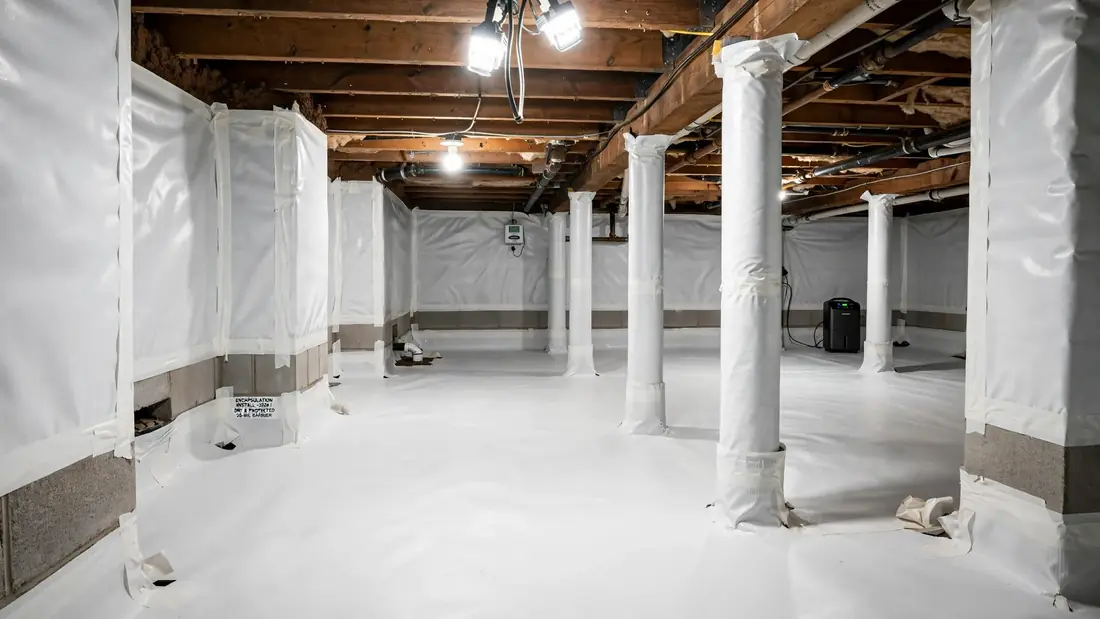
We install a 20-mil reinforced polyethylene liner across the entire floor, run it up the foundation walls, and wrap every pier and post. Seams get a wide overlap, taped with butyl tape made for the job, and the wall liner is mechanically fastened so it cannot slump. This stops ground vapor, the single largest moisture source in a dirt crawl space.
Foundation vents were the twentieth century's answer to crawl space moisture, and in our climate they are the cause of it. We seal the vents and fit a proper sealed access door, closing the rim-joist leaks while we are at it. This is the step that turns the crawl space from "outside" into "inside."
A sealed liner over a water problem is a bathtub with a lid. Before any liner goes down, we deal with liquid water: an interior perimeter drain tied to a sump pump where the site needs it. We never install a liner over active water entry and call it done. Crawl space waterproofing
Sealed air still needs moisture control. We install a commercial-grade crawl space dehumidifier sized to the space, with condensate drained to the exterior or the sump discharge. The dehumidifier is the engine of the system, not an accessory. Crawl space dehumidifiers
We commission the system and prove it: humidity readings at target, every seam and penetration photographed, and a maintenance sheet that tells you what to check and when. The finished space is clean, dry, and inside your home's envelope.
SIGNATURE MODULE
HOW A JOB RUNS
Encapsulation fails when it is done out of order. Each step assumes the previous one is complete.
01
The free inspection comes first. Moisture readings, drainage behavior, framing condition, vent status, insulation, mold mapping. The scope follows the evidence, not a script.
02
Photos of everything, findings in plain language: what is urgent, what can wait, what does not need doing. We show you the readings, not just our opinion. If your crawl space is fine, we say so and leave.
03
Every component priced separately and signed before work starts. Liner, sealing, drainage, dehumidifier. No bundled mystery numbers, no pressure.
04
Drainage first, then clean-out and prep, then the liner, sealed vents, and the dehumidifier commissioned last. Contained work area, photographed when we are done.
Objections, answered straight, about crawl space encapsulation in Hoover.
Published ranges from local contractors put full encapsulation in the Hoover market between $3,500 and $7,000. Square footage, drainage needs, access, and whether structural repair or mold remediation comes first move the number. We quote from an in-person inspection.
Most take two to four working days. Drainage work adds time. Structural repair adds time. We give you a real schedule at the inspection, and we do not start what we cannot finish in the window we promise.
The liner and sealed vents stop vapor and humid air, not liquid water pushed in by hydrostatic pressure. That is what the drainage component is for. If your crawl space takes on water after storms, the scope must include an interior drain and sump.
Yes. Sealing stops new humid air from entering, but moisture still migrates through block walls and the footing. Without active dehumidification, a sealed crawl space will still run above the humidity levels where mold and wood decay thrive.
Usually we remove it and start fresh. Old builder-grade poly is typically torn and thin. Laying a new 20-mil liner over a failing 6-mil sheet traps moisture between the layers and gives you seams you cannot inspect.
Plumbing leaks, rotted joists, failing piers, and existing mold. Encapsulation controls the environment that caused the damage; it does not rebuild what the damage destroyed. When we inspect, we tell you which of these apply before we talk about encapsulation.
Encapsulation doesn't fix structural damage; repair rebuilds it from below. Fix the structure
When water gets in, drainage comes before the liner. Every time. Move the water out
Sizing, placement, and why portables fail under a house. Every sealed system needs its engine. Size the unit
Looking at the whole picture? See all eight crawl space services.
FREE INSPECTION
Every encapsulation we install starts with us in your crawl space, not with a quote over the phone. We measure moisture, check the structure, look at drainage, and tell you exactly what your space needs, including the things encapsulation will not fix. Then we put it in writing, line by line.
Call (205) 208-7286 or send the form. Free inspection, photos, itemized plan. No obligation.
