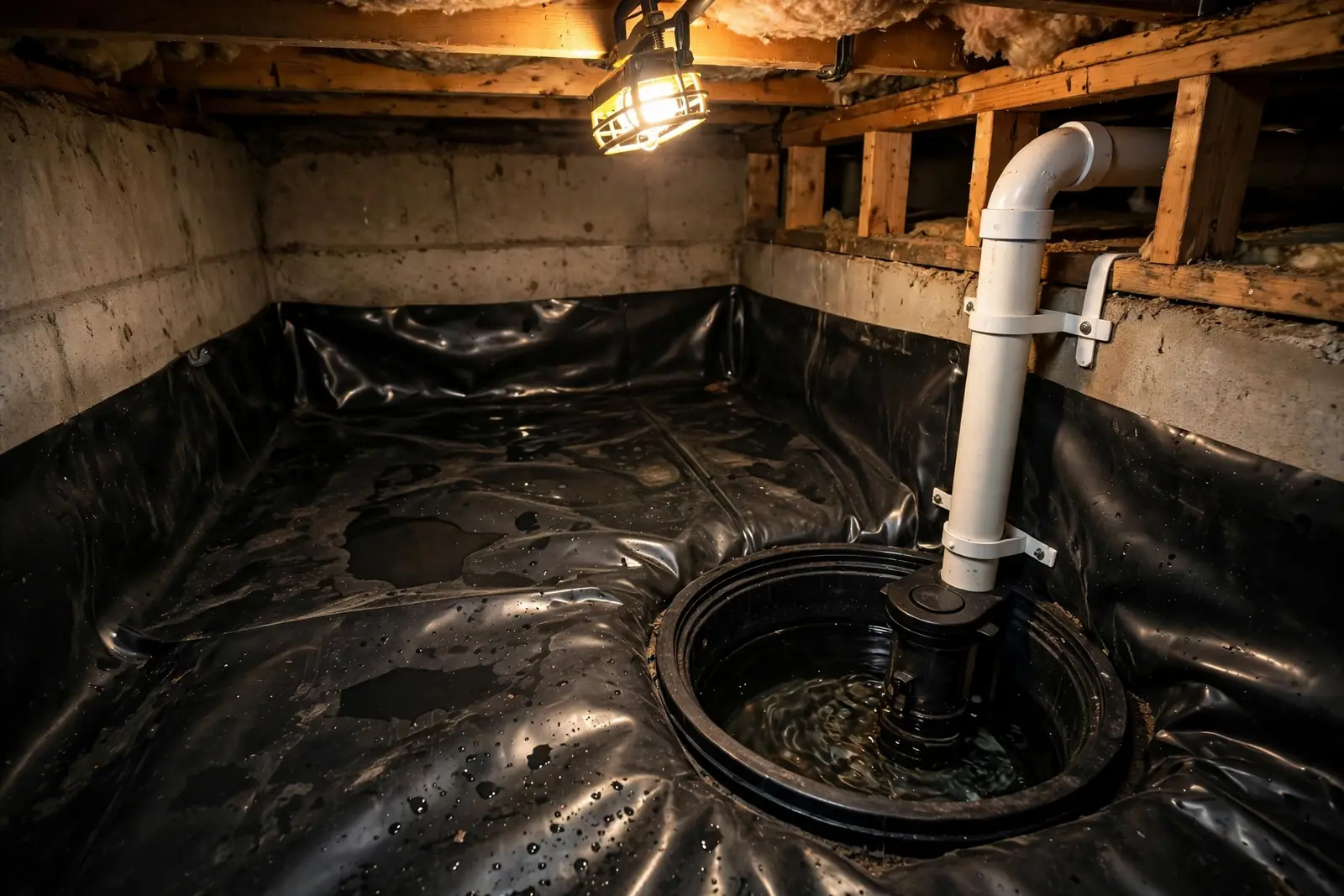
Everything about water management in a Hoover crawl space starts with the ground itself, and ours is red clay.. Shelby County's red clay doesn't behave like sandy or loamy soil: it swells dramatically when wet, shrinks when dry, and holds water against your foundation with a persistence that surprises homeowners from other states. Crawl space drainage in Hoover, AL is engineered for that clay, not for generic soil, and the difference shows in how long the system lasts. When a house needs a sump pump installation in Hoover, AL, the pump gets sized to the water the site actually sees, measured at inspection, not pulled from a catalog.
Call (205) 208-7286 or get a free inspection. We will map your water entry points for free, and we answer our own phone.
Water leaves evidence. These four tell you whether your crawl space has a drainage system, whether it is working, and whether it was ever the right one.
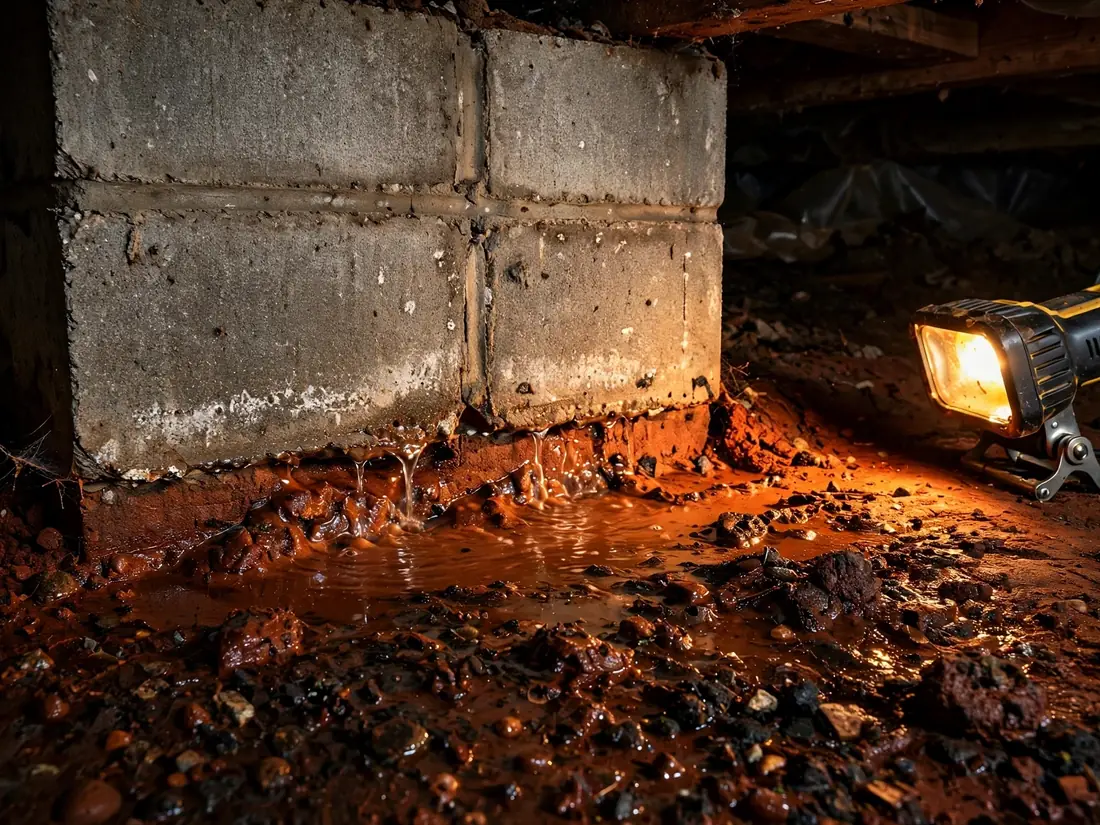
Water pooling on the dirt floor, or tide marks on the block walls recording storms you never knew reached the crawl space. The soil is delivering water faster than the ground can take it away. This is the signature Hoover problem: clay that holds water, not soil that drains it.
A sump pump working perfectly but discharging three feet from the house is pumping the same water in a loop. A pump that never runs in a wet crawl space is a pump that is not where the water is, or a switch that died quietly. Discharge routing is part of the system design, not an afterthought, and a dead switch is the most common pump failure there is.
Water staining at the footing joint, silt deposits, efflorescence on the masonry. Fall and early winter deserve attention: after summer, the clay is at its driest and most contracted, so the season's first heavy rains deliver water straight through those shrinkage gaps. Seepage that returns every year is a drainage scope, not a weather event.
Shelby County red clay is expansive: it absorbs water and swells with tremendous force against foundation walls, then shrinks and cracks as it dries, opening pathways for the next rain. That swell-shrink cycle repeats every wet-dry season, and it is why generic drainage designs from other states underperform here.
Three parts, plus the backup. Each one has a job, and cheap installations fail at the details.
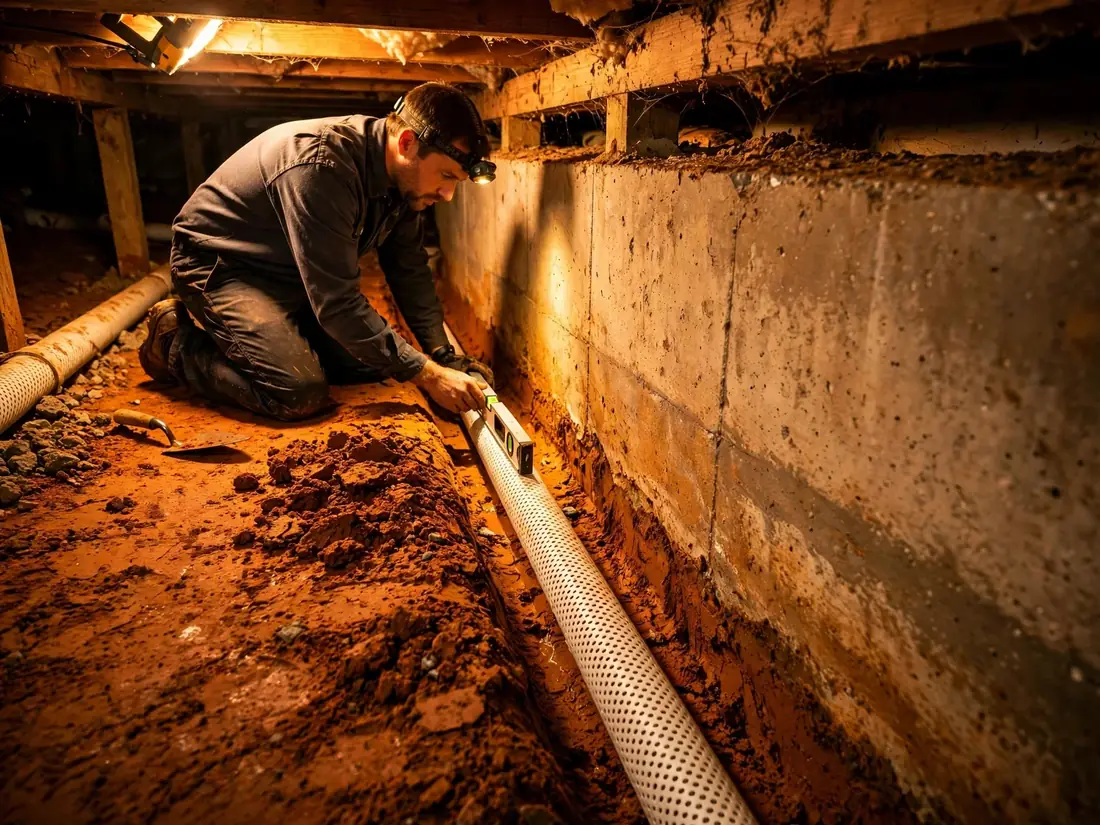
A perforated pipe bedded in washed stone, installed in a trench along the inside of your foundation footing. Water migrating through the soil hits the stone bed, which drains far faster than clay, enters the pipe through its perforations, and flows by gravity pitch to a sump basin. The trench is backfilled with stone to floor level, leaving only a discreet basin lid visible. Washed stone wrapped in filter fabric, because clay fines clog a drain from the outside in.
The basin goes at the lowest point, found with a level, not by guessing. We size by water volume and lift height: most Hoover homes need a 1/3 HP primary pump moving 2,000 to 3,000 GPH at the actual discharge head, and high-water sites get 1/2 HP. Sizing is where cheap installations fail: an oversized pump short-cycles and wears its switch, and an undersized pump cannot keep up in a storm.
Well away from the foundation: 10 or more feet minimum, ideally to daylight at a lower grade or to a storm drain where permitted. We run solid discharge pipe with a check valve so water cannot drain back into the basin. On every discharge we ask one question: where does this water go in a hard rain, and can any of it come back? In Hoover, we check local requirements on storm drain tie-ins before routing there.
Hoover's worst water events arrive with the storms that knock out power. Battery backups, deep-cycle battery plus secondary pump, carry 6 to 12 hours of intermittent pumping, enough for most outages. If your power blinks every thunderstorm, backup is not optional. We quote it as a separate line so you can decide, with the maintenance schedule spelled out.
Linear feet of drain and pump spec drive the price. Complete drainage systems in the Hoover area typically run $3,500 to $8,000: interior French drain priced per linear foot, plus the basin, the pump, discharge routing, and battery backup as separate line items.
What drives your number: linear feet of drain, number of basins, pump sizing, discharge distance and routing difficulty, and soil conditions. Our clay is harder digging than loam, and tight crawl spaces slow the trench work: down to about 18 inches of clearance, interior drainage is workable, and most Hoover crawl spaces run 24 to 48 inches. Tight spaces take longer and cost more, but they are very doable, and we would rather tell you that up front than discover it mid-job.
What you will not get: a generic system, a skipped step, or a pump sized from a catalog. We measure your clearances during the inspection and quote accordingly. Call (205) 208-7286 for the free inspection that engineers it.
HOW A JOB RUNS
Drainage before sealing. The drain makes the encapsulation possible.
01
The free inspection comes first. Water entry points mapped, grading and downspouts checked, clearances measured, water volume assessed. The system gets engineered to your soil and your water.
02
Photos of everything, findings in plain language: where the water enters, what the drain intercepts, what the pump moves. If grading fixes it, we say so and save you the drain.
03
Drain, basins, pump spec, discharge routing, backup: each line itemized and signed before work starts. No bundled mystery numbers.
04
Interior French drain and sump go in while the space is open and accessible, then encapsulation on a dry space. One scope, engineered in order. Contained work area, photographed when we are done.
Straight answers about crawl space drainage in Hoover, AL.
Thirty-plus years with washed stone and filter fabric. The pipe does not wear out; drains fail from sediment clogging, which fabric and proper pitch prevent. The sump pump, at seven to ten years, is the maintenance item, not the drain. Annual check: verify the pump cycles and the discharge flows.
Well away from the foundation: 10 or more feet minimum, ideally to daylight at a lower grade or to a storm drain where permitted. Discharging at the foundation corner just recycles the water back into the soil against your wall.
It manages water at your foundation; it does not lower the regional water table, and it does not need to. The drain intercepts water migrating toward your footing and routes it away before it can pool or pressurize. Anyone promising to "lower your water table" is overselling.
Yes, down to about 18 inches of clearance. Below that it gets into specialized-equipment territory. Tight spaces take longer, with hand digging instead of trenchers, and cost more. We will measure your clearances during the inspection and quote accordingly.
If there is any history of standing water or active intrusion: absolutely yes. Drainage goes in first, then the encapsulation seals over a dry space. If the space has never taken on water and moisture readings are clean, drainage may be unnecessary. The inspection determines which category you are in.
On an existing home, interior, almost always. Exterior waterproofing means excavating around the entire foundation: disruptive and expensive, often several times the cost of an interior system.
The full water-vs-humidity distinction. Know which problem you have. Move the water out
The sealed system that goes on top of a dry space. Get the full system
Water plus time equals growth. Remediation first, then the dry system. Remove it first
Looking at the whole picture? See all eight crawl space services.
FREE INSPECTION
Our free inspection maps your water entry points, checks your grading and downspouts, and sizes a drainage system for your actual soil and water volume. No generic systems, no skipped steps, and the findings are yours to keep whether you hire us or not.
Call (205) 208-7286 to schedule. We serve Hoover and the Birmingham metro, and we answer our own phone.
