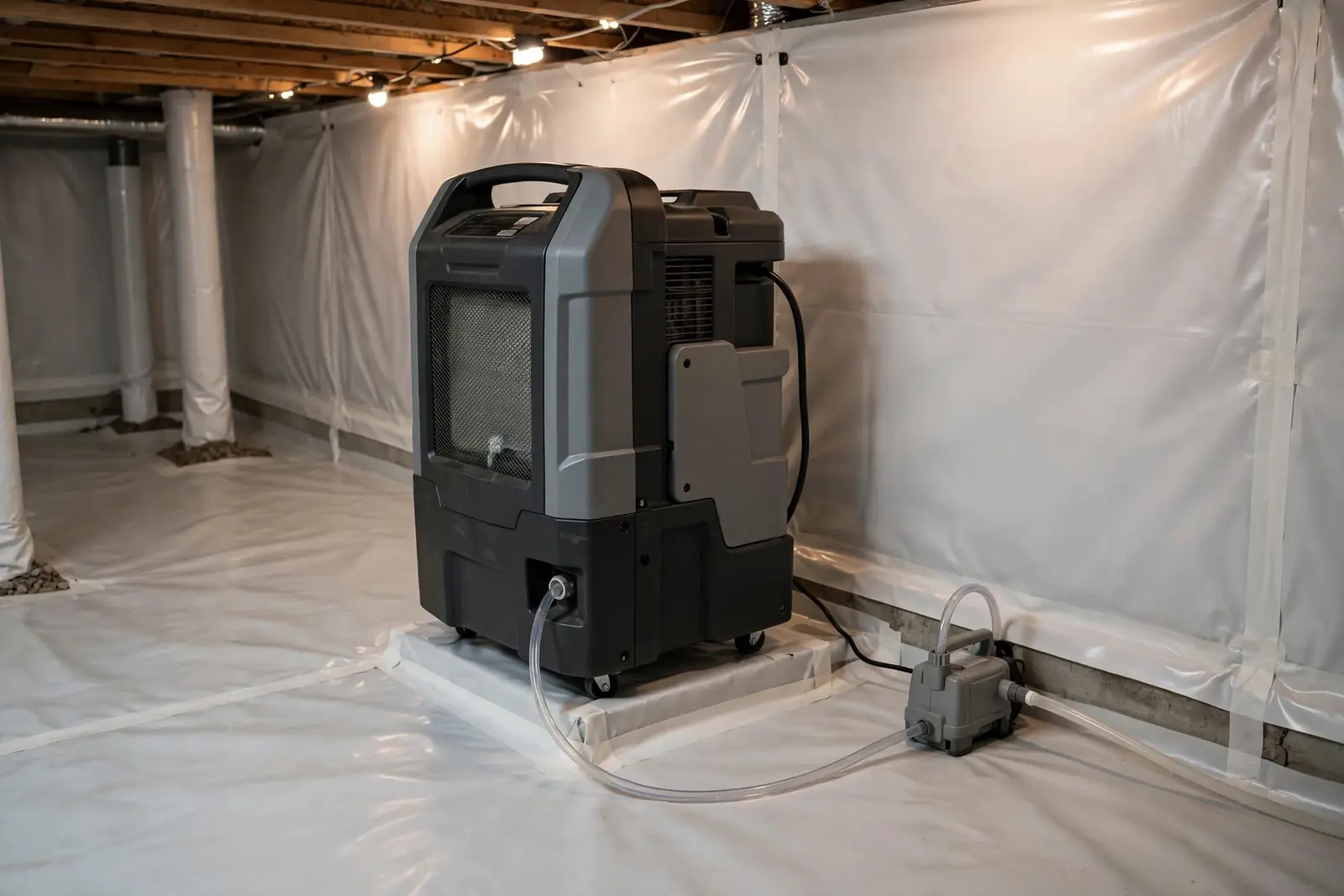
A sealed crawl space without a dehumidifier is a jar with the lid on. You have stopped new humid air from coming in, but the moisture already inside, wicking through block walls, rising at the footing, entering around the sill plate, has nowhere to go. Alabama summers keep the load coming for months: a sealed space without active control still runs in the sixties and seventies of relative humidity. Crawl space dehumidifier installation in Hoover is the engine that keeps a sealed crawl space dry year round, and this page covers sizing, drainage, and exactly why the portable from the big-box store always fails under a house.
Call (205) 208-7286 or get a free inspection. We size from the inspection: readings, not catalog guesses, and we answer our own phone.
Your crawl space has a humidity problem if any of these are happening. A liner and sealed vents handle the sources; the dehumidifier handles the air itself. Two or more of these, and the space needs the engine, not just the seal. All four get measured at inspection.
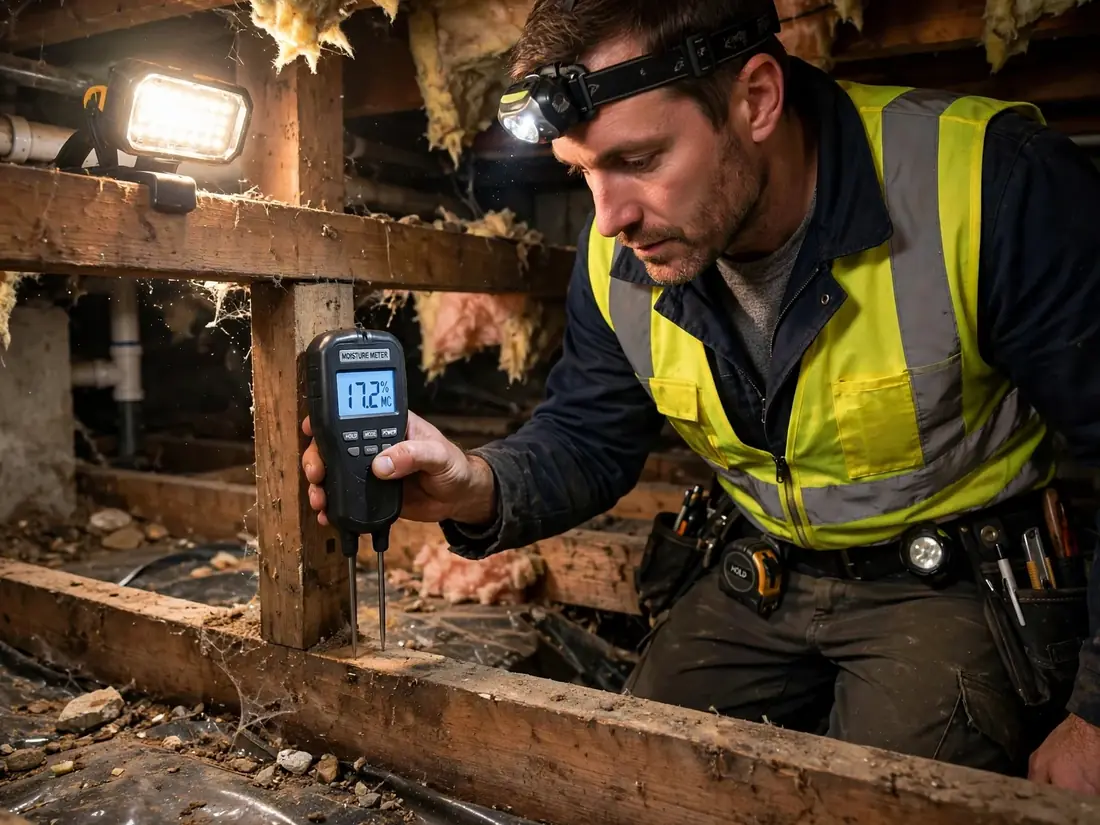
A sealed crawl space in Hoover still runs in the sixties and seventies of relative humidity through summer without active control. That is exactly the range where mold grows on joists and wood decay fungi get to work. Our inspection takes the reading with a meter, not a guess, and tells you where you stand against the 60 percent line.
The thirty-pint portable from the home center frosts over in winter, fills its bucket, and dies in one to three years. We have replaced enough dead portables that we no longer install them, even when asked. They are living-room appliances, not crawl space equipment.
Ductwork sweating through July and August, dripping onto joists and insulation. Cold metal plus humid air equals water, and only controlled humidity breaks the cycle. If your ducts drip, your crawl space air is too wet, sealed or not.
When the air handler pulls return air through a damp crawl space, the whole house gets the smell. Musty air from the vents is the crawl space talking through your ductwork. Dehumidification plus sealing the duct leaks changes what the system breathes.
Sizing and installation are the product. Four parts, and the first one is where most jobs go wrong.
Step 1: square footage. As a planning rule of thumb, a 70-pint crawl space unit covers most Hoover crawl spaces up to roughly two thousand square feet with a moderate moisture load.
Step 2: moisture load. Heavier loads, high water tables, large footprints, or a history of standing water push toward 90 to 120-pint units. Moisture load matters as much as square footage: a tight, well-drained 1,800 square foot space needs less than a damp 1,200 square foot space sitting in clay that never dries.
Step 3: layout. Long, L-shaped, or compartmentalized spaces sometimes need a ducted unit or two units covering separate zones. Final sizing happens at inspection, because the catalog does not know your crawl space.
Crawl space units are built for continuous duty in a harsh environment, with serviceable components and coils that pull moisture at low temperatures without frosting out. Undersizing is the common failure: an undersized unit runs constantly, never reaches target humidity, and burns out early. Oversizing short-cycles and wastes capacity.
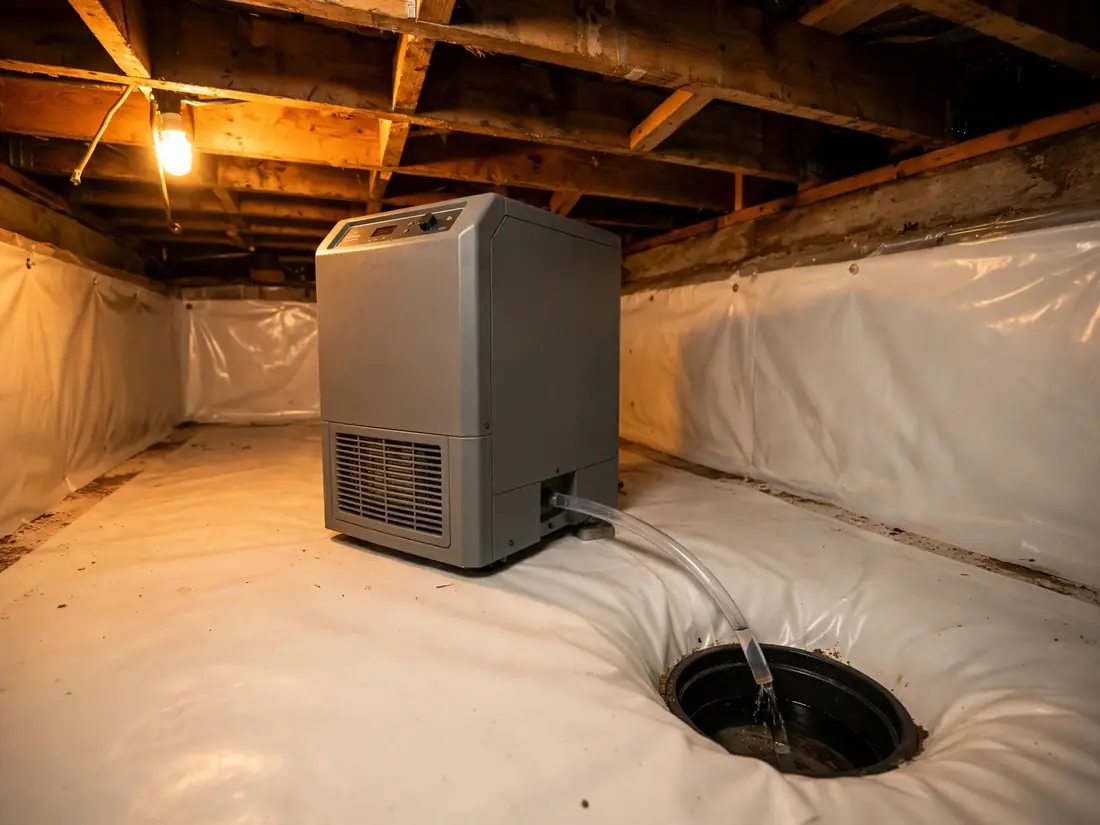
A 70-pint unit pulls nearly nine gallons of water out of the air per day at full load, and that water has to go somewhere reliable without anyone thinking about it. Where the site allows, a gravity drain is the simplest answer: no moving parts, cannot fail. Where the floor sits below the discharge point, we install a condensate pump. Discharge goes to daylight well away from the foundation or into the sump basin. No bucket, ever.
The unit goes where the air moves: central placement, clear airflow, condensate routed before the liner goes down around it. And the rule that makes it all work: a dehumidifier in a vented crawl space is trying to dehumidify the outdoors. Dehumidifier installation assumes sealed vents, or includes sealing them in the same scope.
Unit size and drainage routing drive the price, and both follow the inspection, not a phone guess. A 70-pint unit in an accessible space with a gravity drain is the straightforward end. Larger units, condensate pumps, tight access, and ducted or dual-unit layouts move the number up.
What drives your number: the moisture load the inspection measures, the unit class the space actually needs, whether condensate drains by gravity or needs a pump, and access. We would rather size it right once than sell you a second unit later, which is why sizing happens at inspection from readings, not from a catalog guess over the phone. An undersized unit runs constantly and burns out early; the right unit cycles quietly and lasts for years.
Quoted with the encapsulation scope or standalone by unit size. Either way, the quote is itemized and signed before work starts, with the unit spec and drainage plan spelled out. Call (205) 208-7286 for the free inspection that sizes it.
HOW A JOB RUNS
Sealed vents first. The seal makes the dehumidifier effective; the dehumidifier makes the seal meaningful.
01
The free inspection comes first. Humidity readings, moisture load assessment, layout, drainage options. We size from what the space actually needs.
02
Photos of everything, findings in plain language: the humidity number, the load, the unit class, the drainage plan. You see the readings before you sign anything, and the sizing logic with them.
03
Unit spec, placement, condensate routing, every line itemized and signed before work starts. No bundled mystery numbers.
04
Unit set, condensate routed to daylight or the sump, space brought down to target humidity and verified with a meter reading you can see. We show you the filter schedule. Photographed when we are done.
Straight answers about crawl space dehumidifier installation in Hoover.
As a rough planning figure, a 70-pint unit covers most Hoover crawl spaces up to about two thousand square feet with moderate moisture. But moisture load matters as much as square footage, so we size from the inspection. An undersized unit runs forever and never catches up.
You can, and it will help a little, until it frosts in winter, fills its bucket, or dies in year two. We do not install portables as a solution because we cannot stand behind the result. If budget is the constraint, we would rather talk about staging: seal and liner now, the proper unit when the budget allows.
A typical 70-pint unit draws roughly the power of a few incandescent bulbs while running, and it cycles rather than running constantly once the space is under control.
Nowhere you have to think about. The unit drains through a permanent line to daylight or into your sump system. There is no bucket. If anyone proposes a crawl space dehumidifier with a bucket you empty, they are proposing a living-room appliance for a job it was not built to do.
No. The unit holds the crawl space in a normal indoor humidity band, the same range your living space already runs in. What damages hardwood is the opposite: the damp cycle of an uncontrolled crawl space.
Yes, though less. Winter air holds less moisture, but the crawl space still generates its load from the soil and the block walls. Year-round operation is the point: moisture does not take a season off under your house.
The sealed system the dehumidifier belongs to. Seal first, then the engine. Get the full system
The ground-vapor component of the sealed system. Sealed seams, wrapped piers. Lay a real barrier
Humidity controlled, growth removed, both in one scope. No half jobs. Remove it first
Looking at the whole picture? See all eight crawl space services.
FREE INSPECTION
If your crawl space runs damp, smells musty, or you are sealing the space and need the engine that keeps it dry, we will come measure the humidity, assess the moisture load, and size the right unit. The inspection is free, and the sizing is based on readings, not a catalog guess.
Call (205) 208-7286 to schedule. We serve Hoover and the Birmingham metro, and we answer our own phone.
